hostgator coupon EPICA SEIF AL DIN: Prayer
Showing posts with label Prayer. Show all posts

Friday, April 29, 2011

Fellow Church Ladies


This just in from St Francis de Sales Seminary in the Archdiocese of Milwaukee:

Today, just like in Biblical times, faithful women play an important role in the vitality and future of our Catholic Church. The de Chantal Society is a newly founded group for women who are passionate about supporting the Church, raising their children and grandchildren in the faith, and supporting vocations. The group is named after St Jane Frances de Chantal, a 16th century woman who was inspired by St Francis de Sales to start the Order of the Visitation of Holy Mary.

If you are local, you can check out their meeting schedule here.

Monday, April 18, 2011

A Holy Week Morning Offering

Good morning, good God!

It has begun, Lord: the week we call Holy...

I've read that theologians argue
over whether or not time, or some unit of time,
can actually be holy...

I'll leave that to the scholars this morning
and simply wonder about my growing in holiness
in the week ahead...

Just shy of four days left in Lent, Lord,
and those are my last four chances in 2011
to live as a Lenten Christian...

Four days to be more faithful to prayer,
morning or night or in between,
or whenever you and I can sit down
and just have a chat, one-on-one,
just the two of us, Lord...

Four days to deny myself
some taste or sip, some pleasure or toy,
and experience the emptiness denial creates,
the hunger it leaves to be fed
and the chance to wonder
how I might fill and feed the void...

Wednesday, April 13, 2011

Tuesday, April 12, 2011

The Fifth Sorrowful Mystery: The Crucifixion

Image credit: Crucifixion, Pierre-Paul Prud'hon
The Web Gallery of Art also suggests you listen to this piece by Bach as you're appreciating this painting.

Monday, April 11, 2011

The Fifth Sorrowful Mystery: The Crucifixion


Image Credit: The Crucifixion, Grunewald

The picture shows the central panel of the first view of the Isenheim Altarpiece.

Art for Grünewald did not consist in the search for the hidden laws of beauty - for him it could have only one aim, the aim of all religious art in the Middle Ages - that of providing a sermon in pictures, of proclaiming the sacred truths as taught by the Church. The central panel of the Isenheim altarpiece shows that he sacrificed all other considerations to this one overriding aim. Of beauty, as the Italian artists saw it, there is none in the stark and cruel picture of the crucified Saviour. Like a preacher at Passiontide, Grünewald left nothing undone to bring home to us the horrors of this scene of suffering: Christ's dying body is distorted by the torture of the cross; the thorns of the scourges stick in the festering wounds which cover the whole figure. The dark red blood forms a glaring contrast to the sickly green of the flesh. By His features and the impressive gesture of His hands, the Man of Sorrows speaks to us of the meaning of His Calvary.

His suffering is reflected in the traditional group of Mary, in the garb of a widow, fainting in the arms of St John the Evangelist, to whose care the Lord has commended her, and in the smaller figure of St Mary Magdalene with her vessel of ointments, wringing her hands in sorrow. On the other side of the Cross, there stands the powerful figure of St John the Baptist with the ancient symbol of the lamb carrying the cross and pouring out its blood into the chalice of the Holy Communion. With a stern and commanding gesture he points towards the Saviour, and over him are written the words that he speaks (according to the gospel of St John iii. 30): 'He must increase, but I must decrease.'

There is little doubt that the artist wanted the beholder of the altar to meditate on these words, which he emphasized so strongly by the pointing hand of St John the Baptist. Perhaps he even wanted us to see how Christ must grow and we diminish. For in this picture, in which reality seems to be depicted in all its unmitigated horror, there is one unreal and fantastic trait: the figures differ greatly in size. We need only compare the hands of St Mary Magdalene under the Cross with those of Christ to become fully aware of the astonishing difference in their dimensions. It is clear that in these matters Grünewald rejected the rules of modern art as it had developed since the Renaissance, and that he deliberately returned to the principles of medieval and primitive painters, who varied the size of their figures according to their importance in the picture. Just as he had sacrificed the pleasing kind of beauty for the sake of the spiritual lesson of the altar, he also disregarded the new demand for correct proportions, since this helped him to express the mystic truth of the words of St John.

Sunday, April 10, 2011

The Fifth Sorrowful Mystery: The Crucifixion

Image Credit: Crucifixion Diptych (right panel) Rogier van der Weyden

Friday, April 8, 2011

Thursday, April 7, 2011

Wednesday, April 6, 2011

Monday, April 4, 2011

Sunday, April 3, 2011

Friday, April 1, 2011

The Third Sorrowful Mystery: The Crowning With Thorns

Image credit: Crowning with Thorns, Valentin de Boulogne

Thursday, March 31, 2011

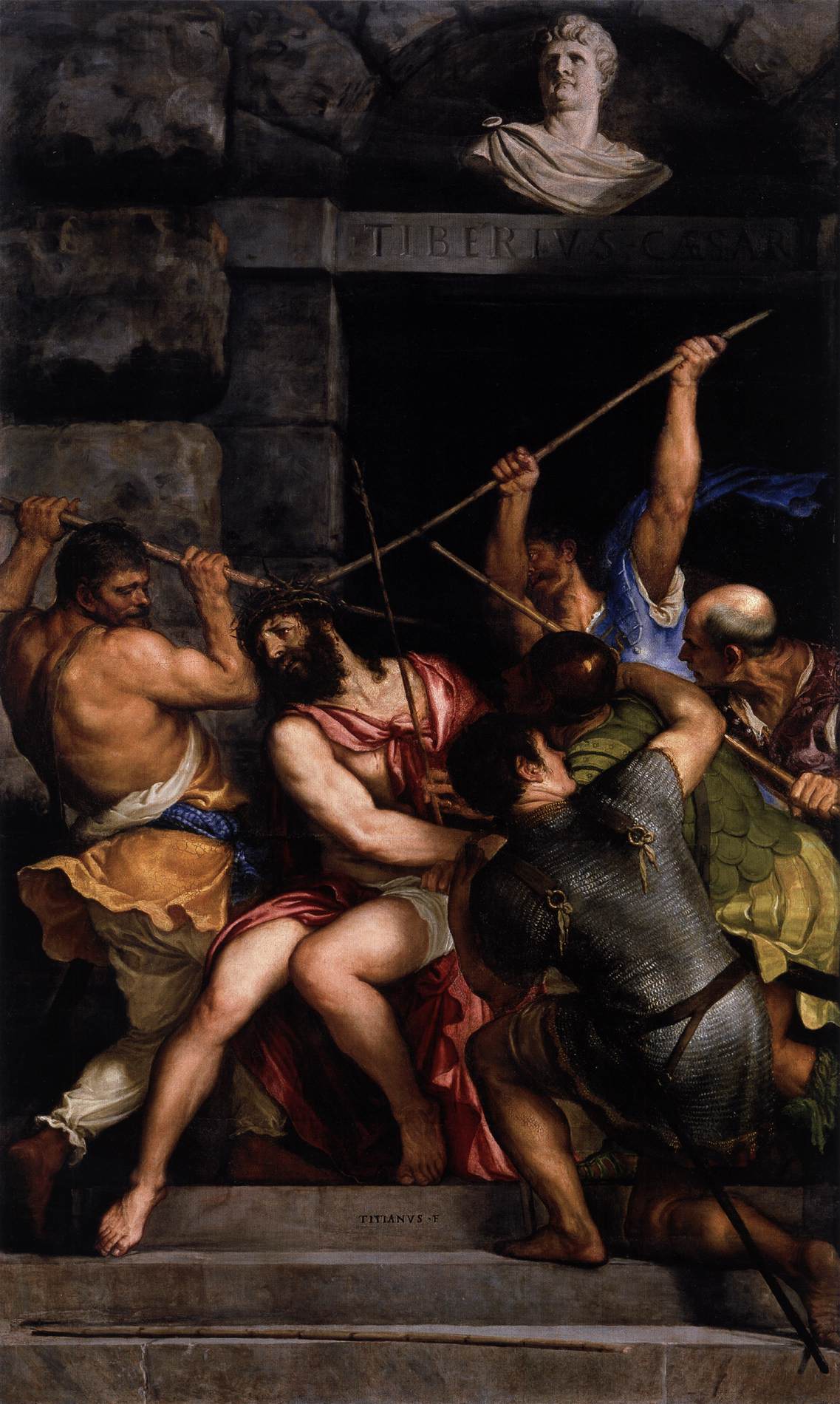
The Third Sorrowful Mystery: The Crowning With Thorns

Image and text credit: Crowning With Thorns, Tiziano
This is a brutal scene, in which Christ's tormentors twist the crown onto his head with their canes, but the violence is relieved and Christ's suffering exalted by the beauty of the colours, which especially in the blue and green to the right are colder than usual in deference to Titian's Roman sources. In Christ's foot extended on the steps, however, Titian pulls out all the Venetian stops and one can sense the blood flowing through the veins under the flesh. The pattern of the canes slices through the massed figures like the strokes of a knife, forming a Trinitarian triangle to the right of Christ's head. An inimitable Titian touch is the cane lying unused on the foremost step, still, shadowless and deadly, like a snake.

Wednesday, March 30, 2011

The Third Sorrowful Mystery: The Crowning With Thorns


Image and text credit: Crowning With Thorns, Sir Anthony Van Dyck
The contrast between the serenity of Christ and the villainy of his captors is vigorously conveyed in this early work by Van Dyck. The composition, as so often, is based on a prototype by Titian, of whom Van Dyck was a passionate admirer. But the influence of Rubens is also crucial, and the presentation is typically baroque: the viewer is forced into the role of a close but helpless witness of the violence enacted. The effect is reinforced by Van Dyck's textures - for instance the exposed and brilliant chest of Christ against the gleaming precision of the axe above or the fluid musculature of the tormentor beside it.

Tuesday, March 29, 2011

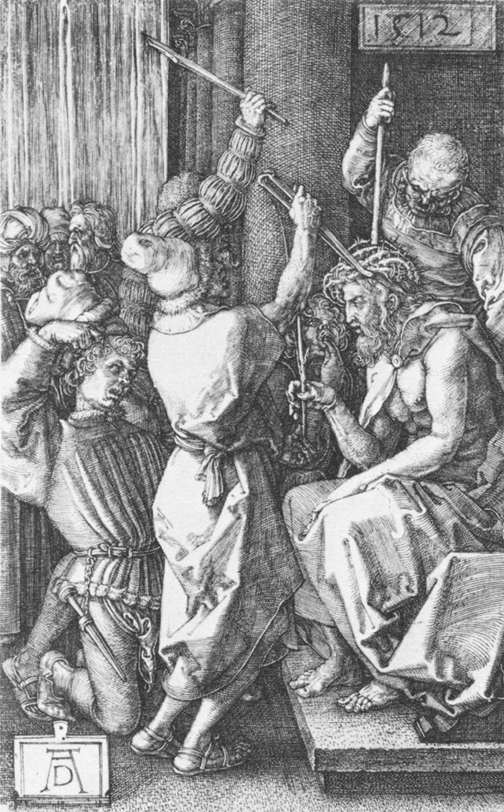
The Third Sorrowful Mystery: The Crowning With Thorns

Image credit: Christ Crowned With Thorns (No. 7), Durer

Monday, March 28, 2011

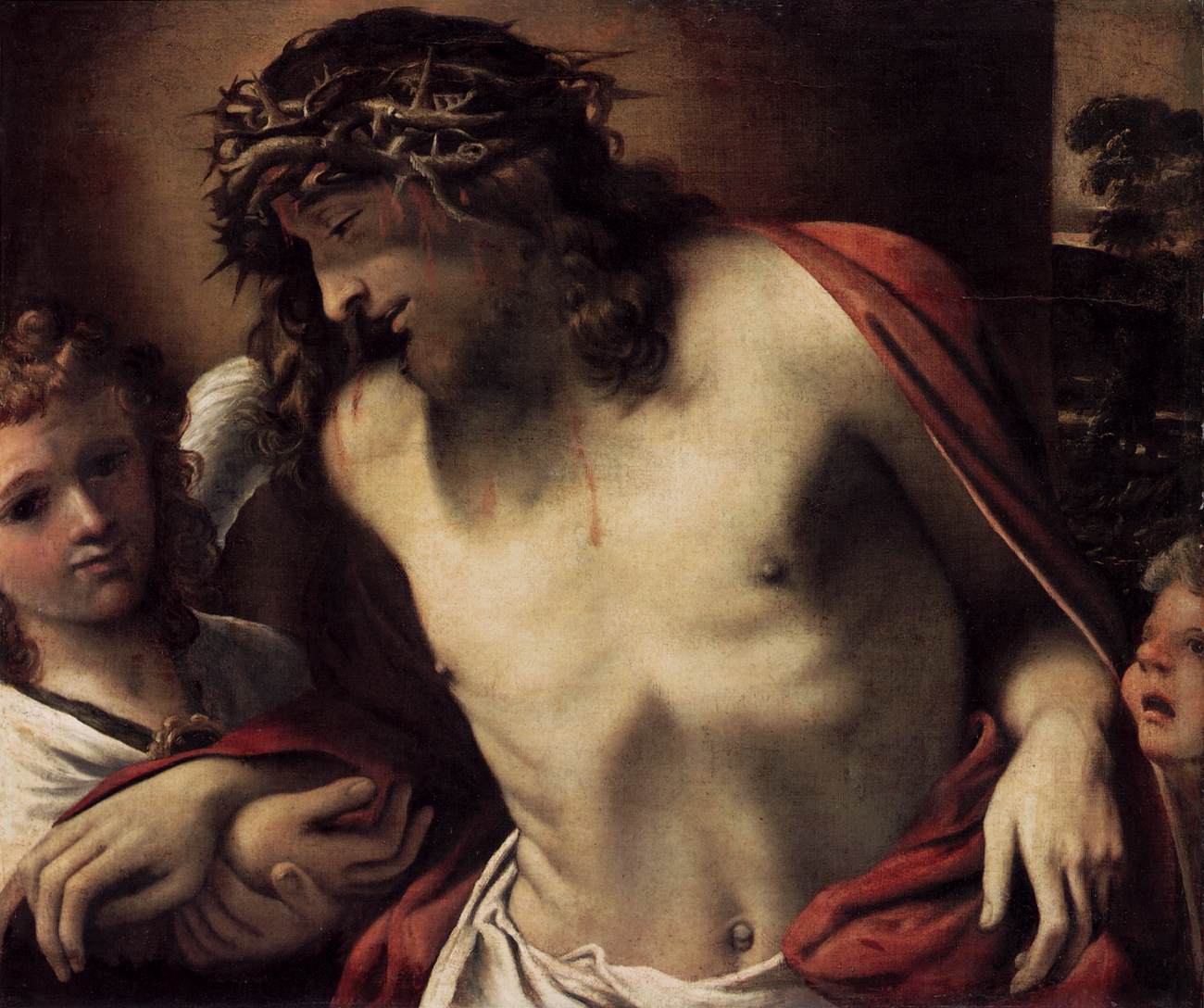
The Third Sorrowful Mystery: The Crowning With Thorns

Image and text credit: Christ Wearing the Crown of Thorns, Supported by Angels, Carracci
Christ, shown at the centre of this work as a half-length figure supported by two angels, dominates the picture. His naked upper body leans forward and slightly to the left, a movement continued by his head, which bears the crown of thorns and is surrounded by a halo. The face of the Saviour, shown in profile, streams with blood and is partly cast in shadow by the heavy crown of thorns; the eyes and mouth are half-open. Christ wears a white cloth about his loins, and a red cloak slips from his shoulders. The angel to the left is clothed in a white cape held together by a brooch and supports Christ's bent right arm with his two hands, placed one on top of the other. To the right a second angel, mouth open, looks upwards in lamentation. The light, shining flesh tones of the Saviour are lent additional intensity by their contrast with the warm, yellowish-brown of the wall behind. To the right is a narrow stretch of countryside with a tree leaning to the right, in a compositional correspondence with Christ's twisted body.

Sunday, March 27, 2011

The Third Sorrowful Mystery: The Crowning With Thorns

Image credit: Head of Christ Crowned With Thorns, Lucas Cranach the elder

Friday, March 25, 2011

The Second Sorrowful Mystery: The Scourging at the Pillar

Image credit: Vir Dolorum (Man of Sorrows), Master Francke

Thursday, March 24, 2011